





 Deathwish 96
 Deathwish 104
 Deathwish 112
 Wildcat 98
 Wildcat 108
 Wildcat 118
 Countach 98
 Countach 104
 Countach 110
 Countach 120
 Sierra 96
 Sierra 104
 Bella 98
 Bella 108
 Siren 98
 Siren 104
 Deathwish Tour 104
 Deathwish Tour 112
 Wildcat Tour 108
 Wildcat Tour 118
 Countach Tour 98
 Countach Tour 104
 Countach Tour 110
 Frankenski
 Carson
 Meridian 117
 Meridian 107
 Chipotle Banana
 Ghost Train
 Comi
Comi
 Meridian Tour 107
 Meridian Tour 117
 Frankenblade
Ever wondered how to pick the right binding for your new skis? You've come to the right place. Let's break it down.
We'll start with the type of skiing you plan on doing, then dial in three variables: release value (DIN), brake width, and boot-sole compatibility.
01 — Type of Skiing
First thing we want to do is pick the type of skiing you're gonna be doing with these new bindings. This mostly comes down to how you access the slopes you're skiing down, and whether that will be through mechanica means (chairlifts, helicopters, etc...) or through human power (walking up hills and mountains).
Resort
Chairlift access
Lifts up, ski down. The most common binding type for skiers and the best option for those who exclusively ski at resorts. We're big fans of the Look Pivot series and the Salomon Strive series for in resort skiing.


Tour
Earn your turns
Bindings have an uphill and downhill mode, allowing you to walk up to the peak, transition, and ski back down. It's hard to compete with the Moment Voyager for strictly touring setups. The Voyager is a modified take on the tried and true ATK Freeraider platform.


Crossover
A bit of both
Hybrid bindings that do both. Typically at a heavier weight than traditional tour bindings, but allows you to use one set of skis for everything. There's quite a few options in this category depending on weight vs downhill performance, from the ATK Hy to the Salomon Shift to the Cast Freetour System.


02 — Release Value / DIN
Ski bindings have a release value range, called DIN, which allows shop techs the ability to adjust bindings to suit your build and skiing style. Your recommended DIN is based on a combination of your height, weight, age, boot sole length (BSL), and skier type (beginner, intermediate, advanced).
The number in a binding name (i.e. Look Pivot 15) is the maximum release value for that binding. Typically, you'll want a binding where you land somewhere in the middle of the range. Higher DIN models = more aggressive skiing and / or larger skiers.
First, you'll want to determine your recommended DIN value, most skiers will fall somewhere between 5 and 9, with a few exceptions.
Bindings are rated and tested to operate properly at all DIN values listed on the binding, so you can set the binding to the min or max value. It is best practice to try and land in the middle of the DIN range when picking out a new binding, so you have room to increase or decrease the value in the future.
03 — Brake Width vs Ski Waist
All bindings are available with different brake widths, measured in millimeters. Pick the brake width that is closest to the waist width of your new skis.
It's okay if the binding brake is slightly wider or slightly skinnier than the ski, use the slider to get a recommended brake width.
We regularly put bindings with 105 mm brakes on skis that are 108 mm wide. If you're on the edge, or are right in the middle of two brake options, give us a call - we'll give you advise on your specific situation.
Slide to find the right brake width for your ski.
04 — Boot Sole Compatibility
The boot-to-binding interface is a very important safety factor when it comes to bindings.
A non-compatible boot and binding combo can lead to pre-releases or restrict the boot from releasing when it should. There's been a lot of ISO norms over the years, and luckily it's getting more simplified.
Some bindings accept multiple types of boots, some are very specific. Refer to the chart below to determine which bindings will accept your boots.
Alpine
The flat, hard-plastic "DIN" sole — best power transfer and the most consistent release. This was the standard for resort boots, and can still be found on specific models.
These work in nearly every resort binding.
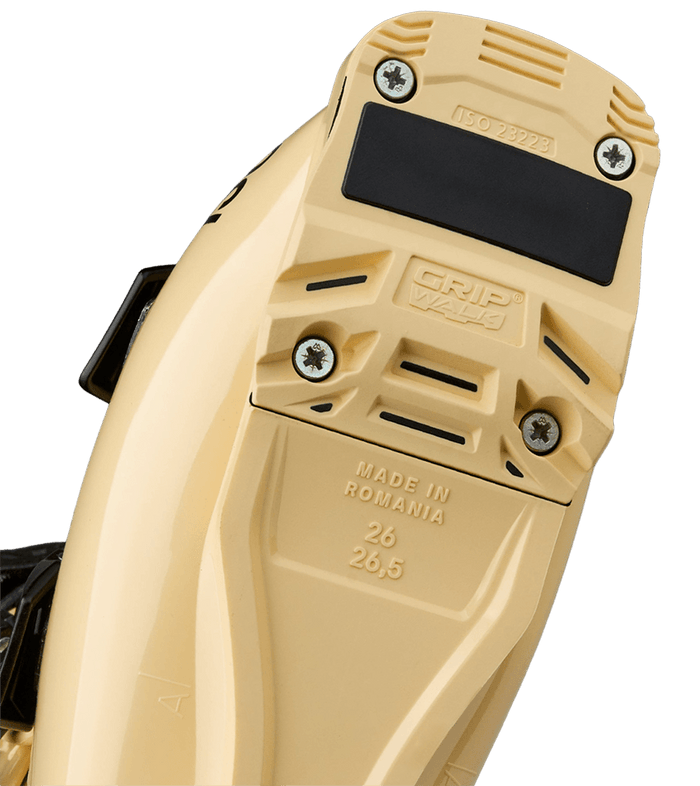
GripWalk
Slightly rockered rubber tread on the bottom maintains consistent release while providing grip for walking through the parking lot. This is the new standard for resort boots.
These require a binding that is GripWalk compatible.
Walk to Ride
A rockered rubber sole that came before GripWalk, made to walk better than a flat alpine sole. GripWalk has since taken over, so WTR is fading out — you'll mostly see it on older boots.
These only work in WTR, multi-norm (MNC), or tech bindings.
Touring
Rockered rubber touring sole, usually with tech (pin) toe fittings, for easier traversal while touring.
These require a true touring binding and most often will not work in resort bindings.
| AlpineISO 5355 | GripWalkISO 23223 | WTRISO 9523 | TouringISO 9523 | TouringNot normed | |
|---|---|---|---|---|---|
Standard AlpineNo compat. logo |
Compatible | Not compatible | Not compatible | Not compatible | Not compatible |
GripWalkGripWalk mark  |
Compatible | Compatible | Not compatible | Not compatible | Not compatible |
WTRWTR mark  |
Compatible | Compatible | Compatible | Not compatible | Not compatible |
MNC / MNMulti-Norm  |
Compatible | Compatible | Compatible | Compatible | Not compatible |
Pin / TechBindings with pins |
Not compatible | Compatible* | Compatible* | Compatible* | Compatible* |
You can find your boot's ISO norm stamped somewhere on your boot, usually on the bottom or around the heel area. Some Touring boots are not normed and are only compatible with pin / tech bindings. Most modern bindings either have a logo displayed on the toe piece and / or have the norm stamped into the underside of the toe piece.
05 — Why We Ride Look & Salomon
We mount thousands of setups a year, and when it comes to resort bindings, we stand behind two brands. Here's why...
Look (Pivot)
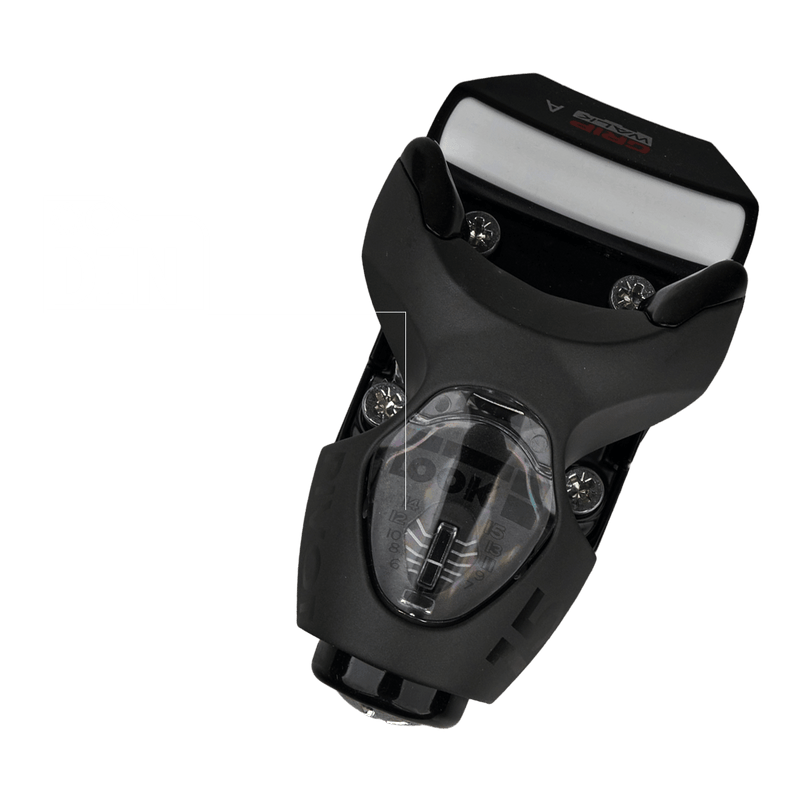
The Pivot's turntable heel provides a great deal of elastic travel (suspension) and excellent retention. This is the go to platform for big mountain athletes to local rippers to everyone in between. The Pivot helps a ski be quicker and more maneuverable, from tight chutes to wide open spaces.
Salomon (Strive)
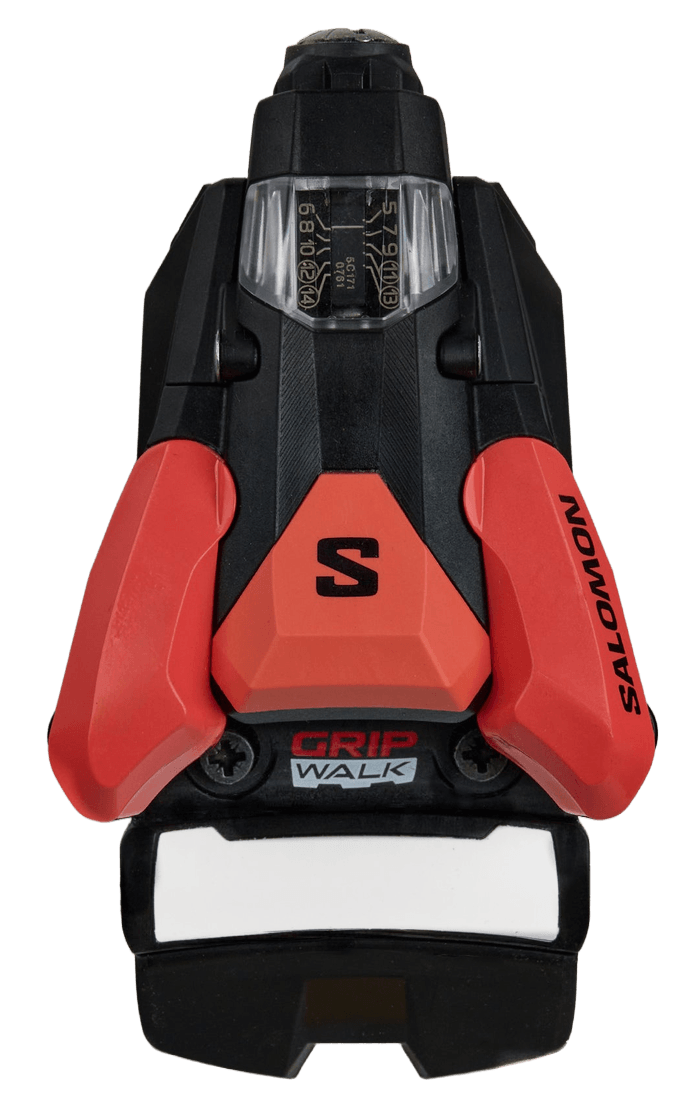
The Strive came onto the scene a few years ago and continues to be a solid choice for a great deal of skiers. Coming in a huge range of DIN ranges and brake widths, there's a Strive for every ski. The Strive helps a ski be more composed and provides faster power transfer to the edge.
The only difference between the Atomic Strive, Armada Strive, and Salomon Strive is the colorway options.
There are other great bindings out on the market, like the Marker Griffon, Marker Jester, and Tyrolia Attack. These bindings also come in a variety of DIN ranges and brake widths.
If you've made it this far and still aren't sure which binding is correct for you, or you just have some questions about something specific, don't hesitate to contact us.